Edge Vision Insights for Retail
Edge computer vision system for retail analytics: shelf monitoring, footfall, queue detection, and loss prevention.
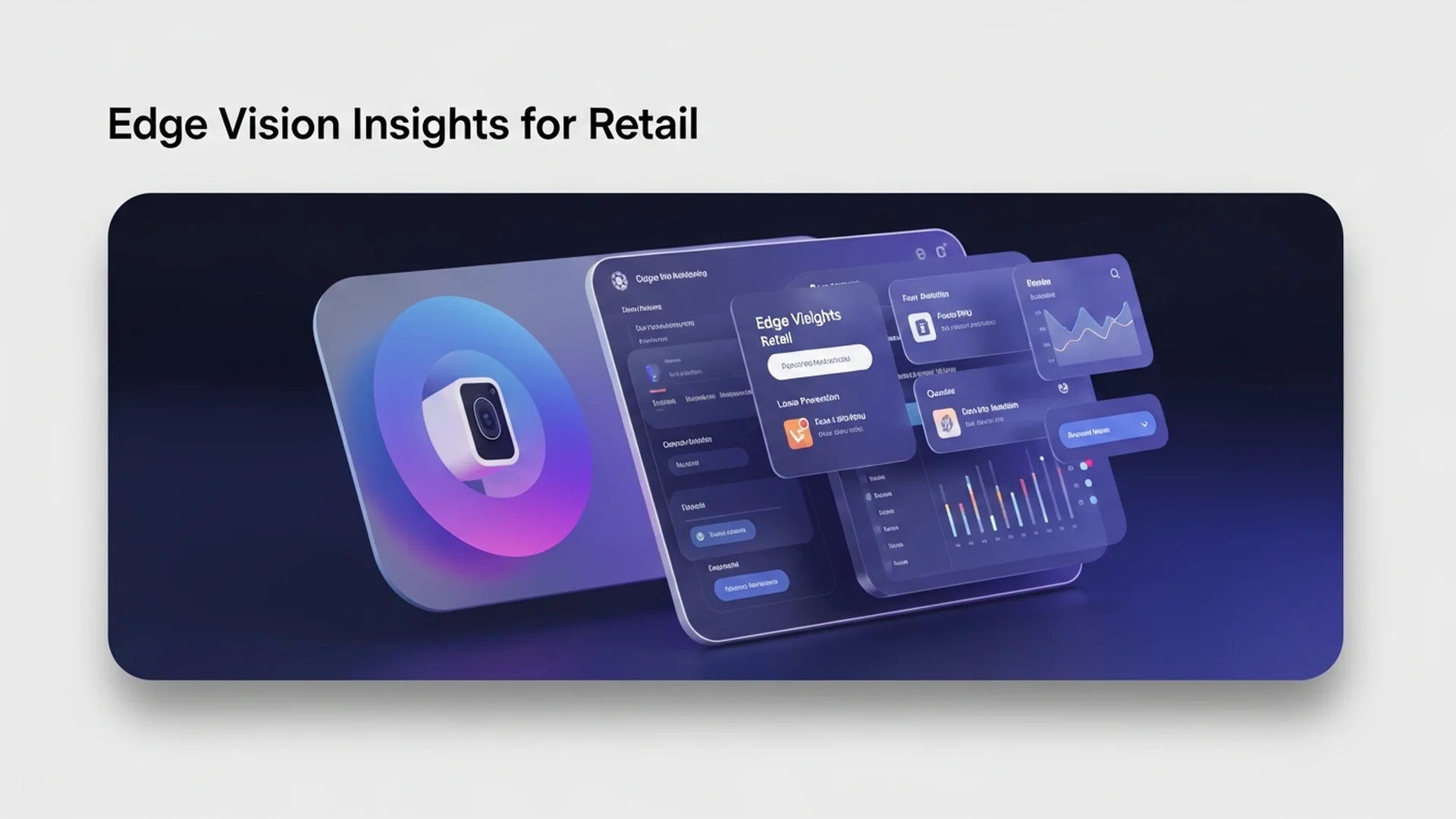
Edge Vision Insights is a compact, privacy-aware computer vision system designed for retail environments. It runs inference close to the camera—on edge devices or compact servers—to provide real-time analytics such as shelf availability, stockouts, queue length, and anonymized footfall counts. By processing video on-site, the system reduces bandwidth, improves latency, and mitigates privacy concerns by anonymizing faces and discarding raw video after aggregation.
SEO keywords: edge vision retail, shelf monitoring system, edge AI retail analytics, anonymized video analytics, on-premise computer vision.
Core capabilities include lightweight object detection and instance segmentation for product recognition, people tracking with anonymization, and analytics dashboards that surface actionable insights for store managers and merchandisers. Integrations with POS and inventory systems enable automated alerts (e.g., restock triggers) and reconciliation between physical stock and digital records.
Quick feature table:
| Feature | Benefit | Implementation |
|---|---|---|
| Shelf monitoring | Reduce stockouts | On-device models + template matching |
| Queue detection | Improve staffing | Edge inference + event triggers |
| Anonymized footfall | Privacy-first metrics | Blurring & event-only aggregation |
| POS integration | Automated reconciliation | Webhooks + periodic audits |
Implementation steps
- Choose hardware footprint and optimize models (MobileNet/YOLO-tiny/EdgeTPU) for on-device inference.
- Implement anonymization (face blurring/pose-only tracking) and local retention policies to comply with privacy laws.
- Build connectors to POS and inventory systems and define reconciliation workflows.
- Deploy edge agents with over-the-air updates and remote monitoring for model drift and health.
- Provide dashboards with trends, alerts, and suggested actions (restock, rearrange, add signage).
Challenges and mitigations
- On-device accuracy: model capacity is limited on edge; combining classical template methods with lightweight neural nets improved robustness for shelf recognition.
- Privacy compliance: strict local retention policies and anonymization pipelines ensure GDPR/CCPA compliance in many jurisdictions.
- Environmental variability: store lighting and occlusions required data augmentation and adaptive thresholds; scheduled re-calibration jobs helped maintain accuracy.
- Scale of deployment: orchestrating many edge devices required automated provisioning, logging, and remote health checks.
Business outcomes and SEO opportunities
Retailers benefit from reduced stockouts, improved staffing, and faster incident detection—leading to better sales and customer satisfaction. SEO content about "edge AI for retail" and "shelf monitoring systems" attracts retail ops, CIOs, and solution procurement teams. Case studies that show improvements in out-of-stock rates and labor optimization drive vendor interest.